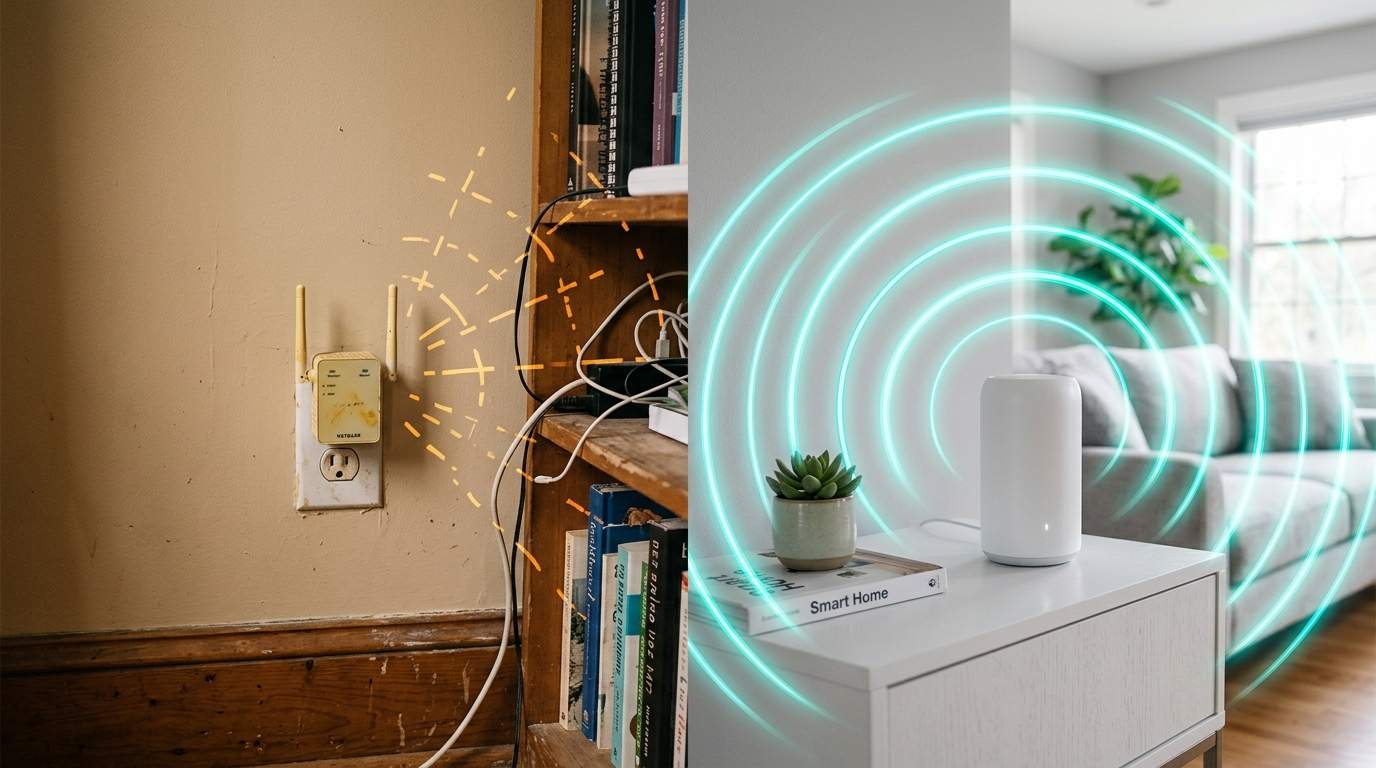
Picture this: You’ve just paid for lightning-fast internet, ready to conquer your day or finally binge that show. You settle in, maybe in your favorite armchair, maybe out on the patio, only to be met by the digital equivalent of quicksand: the spinning wheel of doom, pixelated faces, or a dropped call mid-sentence. Frustrating, right? You’ve tried all the "easy fixes," including that little Wi-Fi extender everyone swears by. But here's a hard truth from someone who's seen countless networks struggle: that "fix" often isn't just not helping, it’s actively making things worse.
E.g. :Effortless UX: A Seamless Trap, Or the Silent Architect of Digital Shackles?
- 1、The Wi-Fi Extender Deception: Why "Boosting" Means Bottlenecking
- 2、Unmasking the Real Culprits: Where Your Wi-Fi Signal Really Dies
- 3、True Solutions for Seamless Connectivity: Beyond the Extender
- 4、The Ultimate Reliability: Embracing Ethernet Backhaul
- 5、Making the Right Choice: Beyond the "Easy Fix"
The Wi-Fi Extender Deception: Why "Boosting" Means Bottlenecking
Many of us fall for the seductive promise of a Wi-Fi extender: plug it in, extend your signal, dead zones banished. Sounds great on paper. But in the real world, it’s like trying to fill a swimming pool with a garden hose that’s also trying to water the entire neighborhood at the same time. The extender often works by catching your Wi-Fi signal and then rebroadcasting it. Sounds efficient, but consider this: the device has to both receive and transmit data on the same radio channel. This fundamental limitation immediately cuts your available bandwidth by at least 50% for any device connected through the extender.
Think of it like this: You bought a sports car capable of 200 MPH (your high-speed internet plan), but then you decide to drive it on a single-lane dirt road (your extender). You might technically cover more ground, but you're going to be slow, bumpy, and frustrated. Data isn't just about speed; it's about consistency and latency – the delay in data reaching its destination. Extenders are notorious for adding significant latency, turning crisp video calls into robotic stutters and online gaming into a pixelated nightmare.
Unmasking the Real Culprits: Where Your Wi-Fi Signal Really Dies
Before you throw your router out the window, let's understand why your Wi-Fi struggles in the first place. Your home, with its walls, floors, and even appliances, is a hostile environment for radio waves. Materials like concrete, brick, and even water pipes are signal killers. A single thick wall can halve your signal strength, and multiple walls? Forget about it. Moreover, interference from neighbors' Wi-Fi, microwaves, or even cordless phones can jam your channels, creating invisible digital traffic jams.

Router Placement: Your First Line of Defense Against Dead Zones
One of the simplest, yet most overlooked, steps is intelligent router placement. Sticking your router in a corner cabinet or behind the TV is like whispering a secret from across a noisy concert hall. Your router should be as central as possible, elevated, and free from obstructions. Imagine a sphere of Wi-Fi radiating outwards; you want that sphere to cover your most used areas optimally. Even moving it a few feet can dramatically improve signal strength in key areas, sometimes negating the need for any "extender" at all.
True Solutions for Seamless Connectivity: Beyond the Extender
If optimal router placement isn't enough, don't despair. There are robust, reliable solutions that don't choke your network. These are the tools that truly bring your network up to speed.
Mesh Wi-Fi Systems: The Smart Network Upgrade
Mesh Wi-Fi systems are the modern answer to whole-home coverage. Instead of one router and a struggling extender, a Mesh system uses multiple "nodes" that communicate with each other to create a single, unified Wi-Fi network. As you move through your home, your devices automatically switch to the strongest signal without you ever noticing a drop.
These systems often come in packs of two or three units, designed to blanket your home. They manage traffic intelligently, prioritize devices, and often use dedicated backhaul channels (a separate wireless highway just for the nodes to talk to each other) to avoid the 50% bandwidth hit of traditional extenders. While the initial investment is higher than a single extender, the difference in performance and reliability is night and day. It’s like upgrading from that single-lane dirt road to a multi-lane, high-speed highway that covers your entire property.
Powerline Adapters: Using Your Home's Electrical Wiring
Another clever trick up the networking sleeve is the Powerline adapter. These devices transmit network data over your home's existing electrical wiring. You plug one adapter into a wall socket near your router and connect it via Ethernet. Then, in a dead zone, you plug another adapter into a wall socket, and voila – you've got an Ethernet port where there wasn't one before. You can then connect a device directly via Ethernet or plug in a small Wi-Fi access point for extended wireless coverage, completely bypassing the Wi-Fi signal issues. This is excellent for older homes where running new Ethernet cables isn't feasible. Just be aware that performance can vary depending on the age and quality of your electrical wiring.
The Ultimate Reliability: Embracing Ethernet Backhaul
For ultimate stability, speed, and reliability, especially for critical devices like gaming consoles, smart TVs, or work computers, nothing beats a wired connection. If you're building a new home or undertaking a major renovation, investing in Ethernet wiring to key rooms is the best network upgrade you can make. Even with Mesh Wi-Fi, using an Ethernet backhaul (connecting Mesh nodes to each other or to the router with an Ethernet cable) drastically boosts performance by offloading inter-node communication from the wireless channels. It's the difference between a direct conversation and shouting across a crowded room.
Making the Right Choice: Beyond the "Easy Fix"
So, what should you buy? If you're struggling with Wi-Fi dead zones, resist the temptation of the cheap extender. Instead, evaluate your needs:
- Small home/apartment with minor dead spots? Optimize router placement first.
- Medium to large home with persistent dead zones and many devices? A Mesh Wi-Fi system is your best bet for seamless, high-performance wireless coverage.
- Specific room needs high-speed, stable connection (e.g., home office, gaming den) but running Ethernet is difficult? Consider Powerline adapters.
- Building or renovating? Run Ethernet cables! It’s an investment that pays dividends for decades.
Your internet speed is only as good as your Wi-Fi's ability to deliver it. Don't let a "solution" designed for convenience undermine the very quality of life and work productivity you're trying to improve. Invest in a network that truly serves you, letting technology get back to its core purpose: making your life simpler and more efficient.