That gut-wrenching moment arrives for most of us: your trusted phone chokes on Instagram, or your laptop stutters during a crucial video call. Instantly, the advertising sirens wail, whispering "upgrade, upgrade!" We're conditioned to believe that any digital hiccup means our gadget is on its last legs, demanding a costly replacement. But what if I told you that most of the time, your "slow" device isn't obsolete; it's just misunderstood, a digital equivalent of a high-performance engine running on bad fuel?
E.g. :Effortless UX: A Seamless Trap, Or the Silent Architect of Digital Shackles?
- 1、The Siren Song of the New Device: Understanding Upgrade Psychology
- 2、Beyond the Specs Sheet: Unmasking the Real Performance Bottleneck
- 3、Becoming Your Device's Best Friend: Practical Optimization for Lifespan Extension
- 4、The Power of Smart Choices: Reclaiming Your Digital Efficiency
- 5、When to Really Say Goodbye: The True Upgrade Signals
As someone who's spent years elbow-deep in hardware schematics and watched global supply chains churn out billions of gadgets, I can tell you a secret: the constant push for the "latest and greatest" often blinds us to the untapped potential in the devices already in our hands. You don't need a brand-new machine to feel the rush of efficiency; you often just need a clearer understanding of the one you already own.
The Siren Song of the New Device: Understanding Upgrade Psychology
We live in a fascinating era where technology evolves at warp speed, yet our fundamental human needs for communication and productivity remain relatively constant. Every year, new flagships arrive, boasting incremental performance gains — a processor 15% faster, a camera with 10% better low-light performance. These aren't insignificant, but they're often sold as revolutionary, convincing us that anything less is inadequate.
This relentless marketing cycle creates a "throwaway" mentality. A device that was perfectly capable two years ago suddenly feels antique because the shiny new model has a slightly curvier edge. This isn't just a drain on your wallet; it’s a colossal waste of resources, contributing to mountains of e-waste and unnecessary manufacturing demands that stress our planet. Before you open your wallet, let's peek under the hood of perception.
Beyond the Specs Sheet: Unmasking the Real Performance Bottleneck
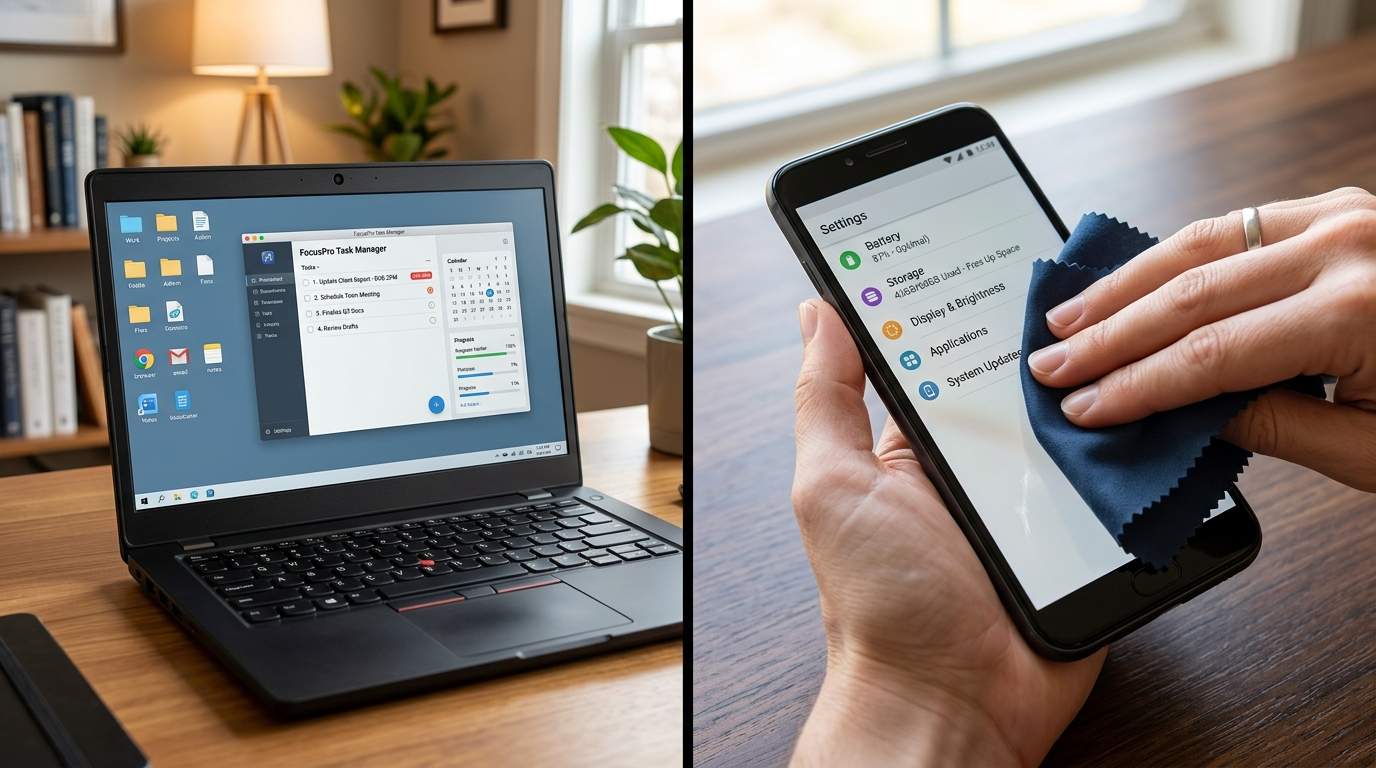
Here’s the thing many don’t realize: modern processors and RAM modules are incredibly powerful. A premium laptop or smartphone from just two or three years ago still packs enough raw computational muscle to handle 90% of daily tasks with ease – web browsing, video streaming, document editing, and even light creative work. The problem isn't usually your hardware failing to keep up; it's something far more insidious.
Your Hardware Isn't Ancient History
Think of your device's CPU like a powerful car engine, and RAM like its fuel tank. Even a two-year-old engine can still hit top speeds if it's got clean fuel and an unblocked exhaust. A study from Statista highlighted that smartphone lifespans are extending, with consumers holding onto devices longer, yet the perception of "need" for an upgrade remains high. Why? Because the bottleneck isn't usually the chip itself, but what's running on it.
The Invisible Culprit: Software Bloat & OS Gremlins
The real performance killer is often software bloat. Operating systems get heavier with each update, adding features many users don't need, silently consuming precious RAM and CPU cycles in the background. Apps, too, are notorious for becoming resource hogs. Remember when Facebook used to take up a few megabytes? Now, its app can swell to hundreds of megabytes, running background processes that constantly drain your battery and slow everything down. A typical web browser with a dozen tabs open can easily consume gigabytes of RAM, making even a powerful machine feel sluggish.
Becoming Your Device's Best Friend: Practical Optimization for Lifespan Extension
So, how do you breathe new life into your "slow" friend without breaking the bank? It's simpler than you think. First, a good digital detox. Clean up your storage – delete old photos, videos, and unused apps. Many devices are slowed by a storage drive that’s nearly full. Second, manage your RAM. Close unnecessary browser tabs and background applications. Most operating systems have built-in tools to show you what's consuming the most resources.
Consider a factory reset for genuinely slow devices. While drastic, it wipes the slate clean, removing years of accumulated digital clutter and giving you a "fresh install" feel. This is a particularly powerful option for phones and tablets. For laptops, regularly defragmenting hard drives (if you still have an HDD) or ensuring your SSD has sufficient free space (aim for 20-25% free) can make a tangible difference.
This "efficiency mentor" approach is perfect for the vast majority of international public users: students, remote workers, casual gamers, and anyone conscious of their budget and environmental footprint. It’s about being smart with what you have. However, if you're a professional video editor running 8K timelines, or a CAD designer manipulating complex 3D models daily, then yes, bleeding-edge hardware might be a genuine necessity for your workflow. For everyone else, optimization is your true power-up.
The Power of Smart Choices: Reclaiming Your Digital Efficiency
Imagine your two-year-old laptop, once a stuttering mess during online presentations, now seamlessly switching between documents, video calls, and a quick web search. This isn't magic; it's the result of smart management. You’ve reclaimed precious processing power, saved hundreds or thousands on an unnecessary upgrade, and reduced your personal contribution to electronic waste.
This renewed efficiency translates directly to improved quality of life. Less frustration, smoother workflows, more time saved. Your phone, once a source of constant irritation, becomes a reliable companion, clearly capturing restaurant details with its night mode because the software isn't fighting for resources. Your laptop, light and thin, continues to be the perfect travel companion, its optimized battery still going strong through a full day of meetings without needing that heavy power brick.
When to Really Say Goodbye: The True Upgrade Signals
Of course, there comes a time when an upgrade is truly justified. If your device suffers from irreparable hardware damage (e.g., a broken screen that costs more to replace than a new device), or if critical software you must use for work or education is no longer supported by your old operating system and hardware. Another key factor is security: if your device no longer receives vital security updates, it becomes a digital liability. These are the real, pragmatic reasons to consider a new purchase, not just a momentary lag opening a social media app.
Before you succumb to the upgrade impulse, give your current device a chance. A little understanding, some practical tweaks, and a dose of digital discipline can often transform your "slow" companion into a perfectly capable machine, ready to serve you for years to come.