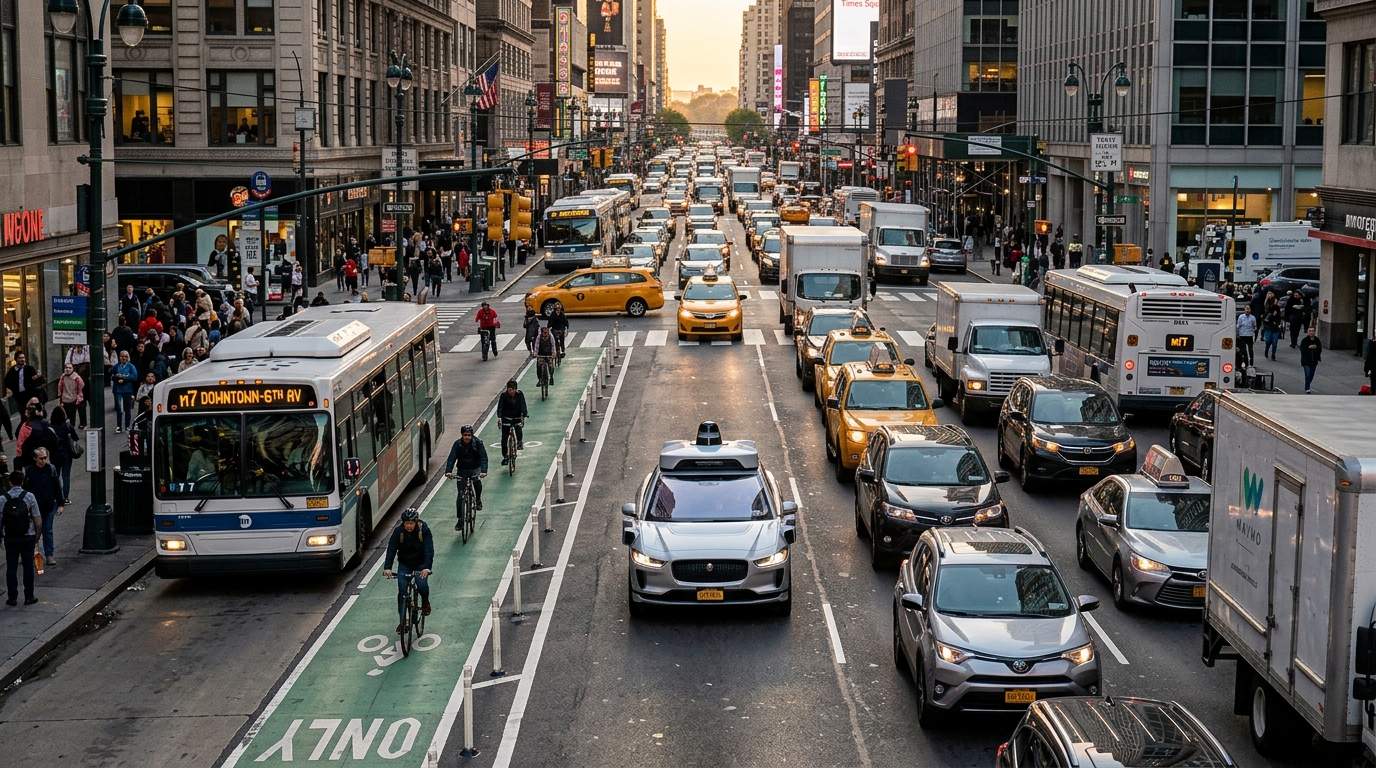
You're stuck, again. The familiar crawl of rush hour traffic engulfs you, punctuated by the silent, almost eerie glide of empty robotaxis. One passes, then another, their gleaming exteriors reflecting the city lights, seemingly cruising with no destination or perhaps just repositioning for their next fare. Meanwhile, the public bus struggles to keep schedule, bike lanes are a chaotic mix of cyclists and delivery vans, and finding a parking spot remains an urban myth. This stark contrast makes one question a foundational promise: Is the vision of "smart cities" powered by self-driving cars actually worsening urban congestion and quietly monopolizing our valuable public street space for private, often underutilized, commercial fleets?
E.g. :The Digital Shovel: Is AI-Powered Archaeology Unearthing Truths, or Burying the Past?
- 1、The Phantom Traffic: Robotaxis and the VMT Surge
- 2、Public Streets, Private Fleets: The Curb Management Conundrum
- 3、MaaS Equity: Autonomous Vehicles and the Future of Urban Transit
- 4、Decoding Autonomous Fleet Dynamics: The Deadheading Delimma
- 5、Beyond the Robotaxi: Reimagining Smart City Mobility
The Phantom Traffic: Robotaxis and the VMT Surge
The core paradox of robotaxis isn't their presence, but their emptiness. The term "deadheading" describes the phenomenon of commercial vehicles traveling without passengers or cargo. For autonomous fleets, this isn't just an occasional occurrence; it's an intrinsic part of their operational model. Once a passenger is dropped off, the robotaxi must either reposition to a high-demand area or return to a charging station, often doing so without a fare. This translates directly into an increase in Vehicle Miles Traveled (VMT) — miles that serve no direct public purpose other than optimizing the fleet operator's logistics.
The Hidden Cost of Convenience
While individual users experience the convenience of on-demand autonomous transport, the aggregate effect can be detrimental. This "phantom traffic" contributes to urban gridlock, prolongs commute times for everyone else, and increases overall energy consumption, even if electric. It’s a hidden cost that society bears for the private convenience and profit of a few, transforming public infrastructure into a primary asset for commercial endeavors without adequate consideration for the broader public good.
Public Streets, Private Fleets: The Curb Management Conundrum
Urban streets are a finite, precious resource, serving myriad functions from transit corridors to public gathering spaces. The proliferation of robotaxis introduces a new claimant for this scarce resource: fleets requiring not just lane space, but also dedicated curb access for pickups and drop-offs, charging, and staging. This intensifies the competition for what urban planners call "curb management," a complex ballet of allocating space for buses, delivery vehicles, taxis, cyclists, and now, autonomous fleets.
Who Owns the Asphalt?
When private autonomous vehicles monopolize curb space or contribute disproportionately to traffic, they effectively privatize a public good. This shift redefines who benefits from our shared infrastructure. City planners face the challenge of balancing the promise of efficient MaaS (Mobility as a Service) with the reality of ensuring equitable access and efficient use of public space. The current trajectory suggests an imbalance, where the pursuit of private operational efficiency might inadvertently erode the public utility of urban streets.
MaaS Equity: Autonomous Vehicles and the Future of Urban Transit
The vision of MaaS promises an integrated, on-demand transportation network that could reduce private car ownership and enhance accessibility. However, the current deployment of robotaxis raises concerns about MaaS equity. If autonomous fleets are primarily concentrated in affluent areas or during peak profitable hours, they risk creating a two-tiered system, leaving underserved communities with diminished public transit options and exacerbated disparities.
The real revolution in mobility should enhance, not undermine, public transportation and active mobility solutions like cycling and walking. A surge in VMT from robotaxis, coupled with their potential to divert ridership from public transit, could paradoxically lead to less equitable and less sustainable urban environments, further entrenching car-dependency rather than alleviating it.
Decoding Autonomous Fleet Dynamics: The Deadheading Delimma
Understanding the algorithms that govern autonomous fleet dynamics is crucial to addressing the deadheading dilemma. Fleet operators constantly optimize for factors like vehicle availability, battery charge, passenger demand, and repositioning efficiency. While these algorithms aim to maximize service uptime and revenue, they often do so within a framework that doesn't fully account for externalized costs like congestion or air quality.
The challenge lies in engineering these complex systems to not only serve private profit motives but also to integrate seamlessly and beneficially within the broader urban ecosystem. This requires a shift from purely commercial optimization to a more holistic, city-centric approach that incentivizes shared rides, minimizes empty miles, and prioritizes public good over mere vehicle utilization rates.
Beyond the Robotaxi: Reimagining Smart City Mobility
The emergence of robotaxis forces us to critically re-evaluate the "smart city" narrative. True smart mobility extends beyond merely automating individual vehicles; it encompasses a holistic, integrated system that prioritizes sustainability, equity, and public benefit. This means robust investments in public transit, protected infrastructure for active mobility, and intelligent urban planning that guides the deployment of all transportation modes.
We stand at a critical juncture. The technology for autonomous vehicles is undeniably advanced, but the societal frameworks for their integration are still nascent. The dividends of truly transformative mobility will only materialize if we collectively demand systems that serve all citizens, enhance public spaces, and contribute to a healthier, more accessible urban future, rather than simply paving the way for more "digital shackles" in the form of endless, empty vehicles.