Across continents, a familiar tension plays out: the grinding halt of a major infrastructure project, whether a new highway or a sprawling housing development, due to the unexpected discovery of extensive archaeological remains. News reports quickly tally the immense financial burden on developers and taxpayers, highlighting lost revenue and escalating costs. Yet, standing amidst the newly exposed earth, archaeologists passionately articulate the irreplaceable scientific and cultural value of what lies beneath. The public, caught in the crossfire, is sharply divided, torn between the urgent demands of modern progress and the profound call for thorough preservation. This isn't merely a conflict of timelines; it's a fundamental questioning of how we value our shared history in an accelerating digital age.
E.g. :Paying for Gigabit Internet? Your Wi-Fi Speed Has a Home Network Secret
- 1、The Immovable Object Meets the Irresistible Force: Development vs. Cultural Preservation
- 2、Non-Invasive Eyes: LiDAR, GPR, and Accelerated Digital Heritage Assessment
- 3、AI's Predictive Gaze: Revolutionizing Archaeological Planning with Smart Algorithms
- 4、The Digital Dilemma: Stratigraphy, Context, and the Soul of the Past
- 5、Navigating the Future: Towards a Balanced Era of AI Archaeology and Deep Discovery
The Immovable Object Meets the Irresistible Force: Development vs. Cultural Preservation
The core of this escalating conflict lies in the inherent mismatch between modern society's demand for rapid land turnover and economic growth, and the painstaking, resource-intensive process of traditional archaeological investigation. Digging, sifting, cataloging, and interpreting an ancient site can take years, demanding significant funding and specialized expertise. These delays, however, translate directly into massive financial penalties for developers, creating immense pressure to find faster, cheaper ways to clear the path for progress.
Non-Invasive Eyes: LiDAR, GPR, and Accelerated Digital Heritage Assessment
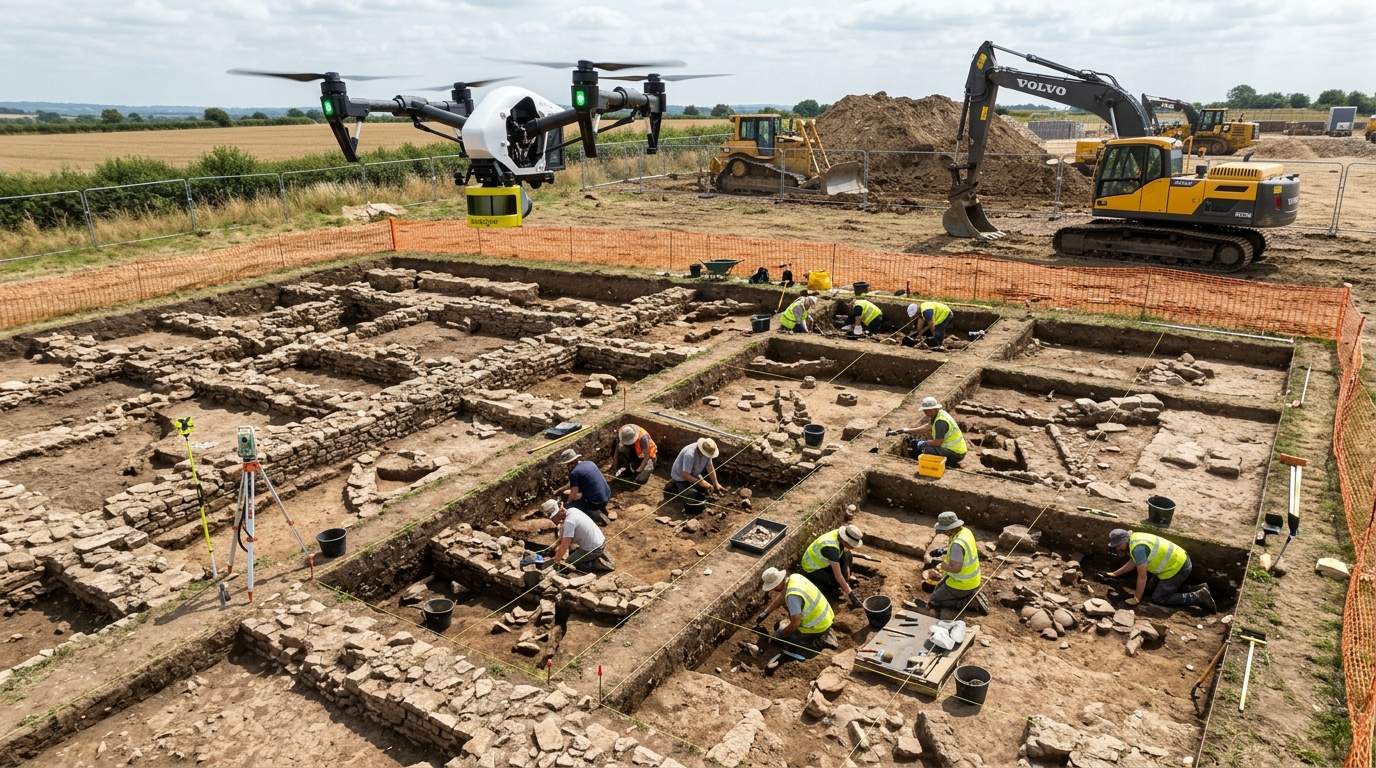
Enter the promise of new technologies: a suite of non-invasive archaeological methods designed to bridge this gap. Technologies like Light Detection and Ranging (LiDAR) and Ground Penetrating Radar (GPR) are rapidly transforming initial heritage assessments. LiDAR, often deployed from drones or aircraft, uses pulsed laser light to measure distances, creating highly detailed 3D maps of surfaces, even penetrating dense foliage to reveal subtle archaeological features invisible from the ground. Similarly, GPR sends radar pulses into the ground and detects reflected signals, mapping subsurface structures without disturbing the soil.
Mapping the Invisible: Creating a Digital Twin of History
These non-invasive techniques generate vast datasets, forming a "digital twin" of a site – a precise, virtual representation that can be analyzed and re-analyzed. This capability allows archaeologists to quickly identify potential sites, map their extent, and even infer internal structures, dramatically reducing the time and cost associated with preliminary surveys. Such efficiency is invaluable in Cultural Resource Management (CRM), where rapid decision-making can prevent costly delays and inform development plans.
AI's Predictive Gaze: Revolutionizing Archaeological Planning with Smart Algorithms
Beyond simply mapping, Artificial Intelligence (AI) takes these digital insights a step further. AI-powered predictive modeling leverages these non-invasive scans, alongside historical maps, environmental data, and known archaeological site patterns, to forecast where other undiscovered remains are most likely to be located. By sifting through complex data far faster than any human, AI can help prioritize areas for further investigation or identify zones where construction might proceed with minimal heritage impact. This shifts archaeology from reactive discovery to proactive, data-driven planning, theoretically optimizing both preservation and development timelines.
The Digital Dilemma: Stratigraphy, Context, and the Soul of the Past
Despite their undeniable utility, the acceleration offered by these technologies introduces a profound ethical and scientific dilemma. The question arises: are we, under the immense pressure of developer timelines and financial incentives within CRM, inadvertently accepting a superficial "digital twin" of our past? The very essence of archaeological discovery often lies in stratigraphy – the meticulous study of superimposed layers of soil and artifacts, each representing a distinct period in time. This layered context is irreplaceable; it tells the story of change, interaction, and meaning over millennia.
Beyond the Data Points: The Irreplaceable Human Story in Digital Heritage
A digital twin, no matter how detailed, is a snapshot. It lacks the subtle nuances, the tactile evidence, the organic and inorganic relationships that traditional excavation reveals. The full post-excavation analysis, involving laboratories and deep academic interpretation, is what transforms scattered artifacts into coherent human stories. If we rely solely on surface scans and predictive models, we risk sacrificing the deep human narratives embedded within these strata for economic expediency, potentially selling future generations short by reducing a rich, multi-dimensional history to mere data points.
Navigating the Future: Towards a Balanced Era of AI Archaeology and Deep Discovery
The challenge is not to reject technology, but to apply it wisely. AI and non-invasive methods are powerful tools for initial assessment and macro-level understanding, serving as invaluable guides to prioritize and focus traditional excavation where it is most critical. They can highlight areas of highest potential, allowing resources to be deployed more effectively for deeper, context-rich investigation. The true dividend that changes the future lies not in replacing human inquiry with algorithms, but in augmenting it.
The path forward demands a nuanced integration, where technological efficiency serves as a prelude to thorough, human-led inquiry. We must cultivate a framework where digital speed does not become a "digital shackle" around the neck of comprehensive knowledge. The aim should be to harness AI to better safeguard the past, ensuring that our progress in the digital realm doesn't inadvertently bury the very truths we claim to unearth, preserving not just objects, but their profound, irreplaceable stories for all future generations.