Browsing through the sleek, AI-curated collections on our favorite fast fashion applications often evokes a distinct sense of discovery, a feeling that algorithms have truly understood our individual aesthetic, presenting us with styles that feel uniquely "us." Yet, this fleeting satisfaction frequently dissolves into a familiar pattern: within weeks, the very garment we believed to be a reflection of our distinct taste suddenly proliferates across social media feeds, mirroring countless others, before ultimately contributing to the ever-growing piles in global landfills. This experience presents a critical paradox, challenging the proclaimed benefits of AI in fashion.
E.g. :Effortless UX: A Seamless Trap, Or the Silent Architect of Digital Shackles?
- 1、The Allure of Algorithmic Personalization in AI Fashion
- 2、The On-Demand Manufacturing Paradox: Promise vs. Reality
- 3、Decoding the 'Unique Style' Funnel: Textile Waste and Accelerated Obsolescence
- 4、The Digital Shackles: When AI Optimization Becomes Overconsumption
- 5、Beyond the Hype: Reimagining AI Fashion for True Sustainability
The Allure of Algorithmic Personalization in AI Fashion
The promise of AI in fashion initially captivated us with its potential for unprecedented personalization. Leveraging vast datasets of user behavior, purchasing history, and even external trend signals, these sophisticated algorithms construct detailed profiles, offering garments and accessories precisely tailored to individual preferences. This capability extends beyond simple recommendations, venturing into generative design, where AI can conceptualize novel patterns, textures, or even entire garments based on specific inputs or evolving trends. The technological prowess behind this appears genuinely transformative, suggesting an era where fashion is no longer a one-size-fits-all proposition but a finely tuned expression of self.
This deep dive into consumer data allows brands to anticipate and even subtly influence demand, creating a seamless, almost intuitive shopping experience. It feels as though the digital storefront is reading our minds, presenting us with the perfect item just as we realize we desire it. Such precision, proponents argue, minimizes guesswork in production, leading to less overstock and, consequently, less waste—a seemingly elegant solution to one of fashion's most pressing environmental problems.
The On-Demand Manufacturing Paradox: Promise vs. Reality
Industry leaders frequently champion generative AI and advanced analytics as the ultimate tools for achieving a truly circular economy, primarily through precise demand forecasting and on-demand production. The vision is compelling: garments are only produced when a customer places an order, drastically reducing unsold inventory and the associated textile waste. This model, often cited as the future of sustainable fashion, theoretically eliminates the inefficiencies of traditional bulk manufacturing.
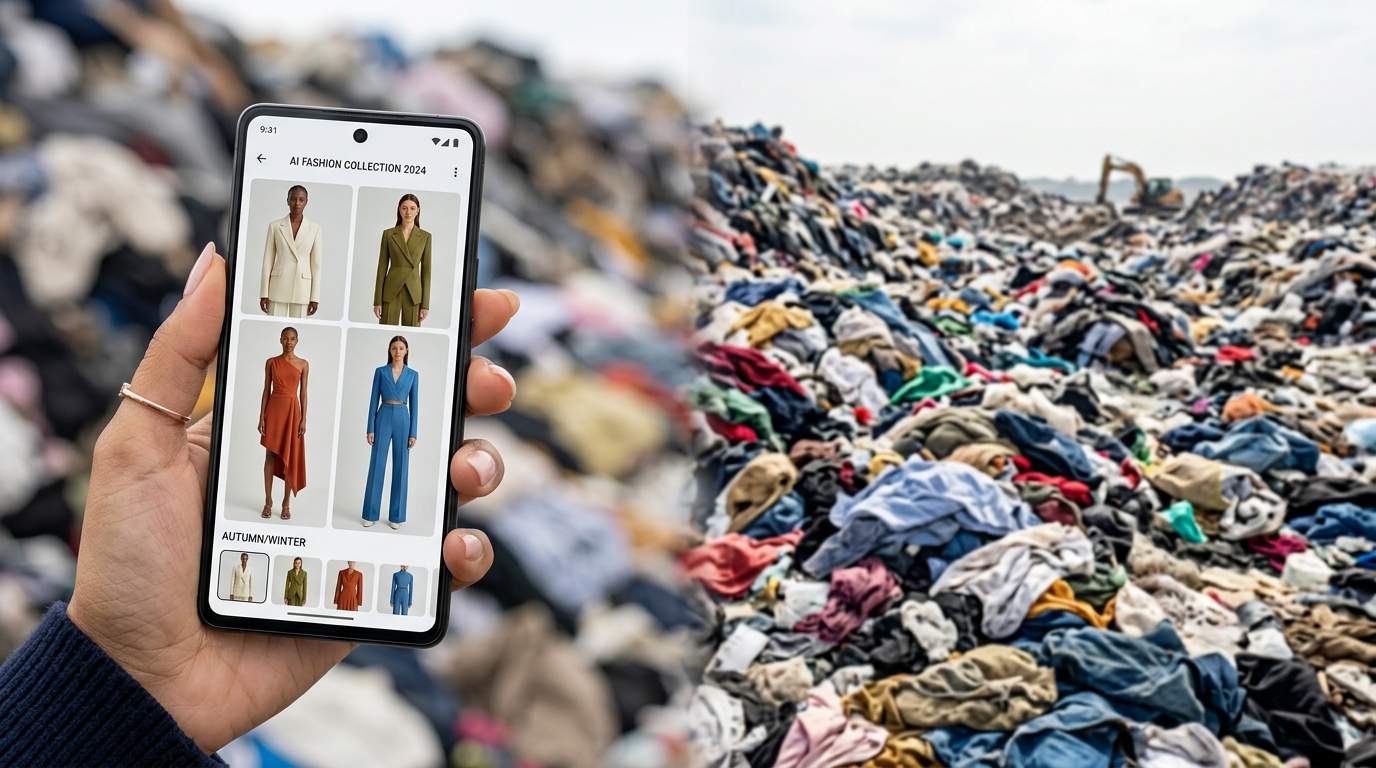
However, the practical application of this "on-demand" model often falls short of its lofty aspirations, especially within the fast-fashion ecosystem. While some brands genuinely embrace leaner production, many leverage AI not just for genuine customization but to rapidly identify and scale up emerging trends. The speed at which an AI can detect a burgeoning style and translate it into a production order often means that "on-demand" becomes "on-demand fast," accelerating the trend cycle rather than slowing it down.
The Data-Driven Illusion of Scarcity
Algorithmic personalization, rather than creating truly unique pieces, often acts as a highly efficient filter, converging diverse individual tastes onto a narrow set of "most likely to buy" items. This creates an illusion of individualized style while funneling a massive user base toward the same AI-identified "hot" products. The data-driven insights, instead of fostering bespoke creation, often optimize for maximum market penetration, making popular items appear uniquely curated for each person, generating a perceived scarcity that fuels rapid purchases.
From Niche Trend to Mass Production Overnight
When AI identifies a micro-trend, its insights allow brands to quickly pivot production, turning a niche aesthetic into a mass-market phenomenon almost overnight. This agile response means that what might have organically evolved over months now saturates the market in weeks, driving accelerated consumption. The speed, while impressive from an operational standpoint, directly undermines the longevity of trends and contributes to the rapid obsolescence of garments as consumers chase the next AI-predicted wave.
Decoding the 'Unique Style' Funnel: Textile Waste and Accelerated Obsolescence
The underlying mechanics of this AI-driven fast fashion paradigm often optimize for profit through speed and volume, rather than genuine sustainability or individual expression. The algorithms are incredibly effective at identifying consumer desires and packaging them into attractive offers. However, this often translates to a sophisticated funnel designed to accelerate consumption cycles. What appears as "personalization" can, in practice, be a highly efficient system for guiding millions of users towards a curated selection of rapidly produced, trend-driven items.
This continuous cycle of AI-identified trends, rapid production, and widespread dissemination inevitably feeds the global textile waste crisis. Garments, produced in huge quantities to meet algorithmically generated demand, are often of lower quality to enable lower price points, further shortening their lifespan. The result is a perpetual churn where perceived "unique style" quickly becomes disposable fashion, designed for fleeting relevance rather than enduring value.
The Digital Shackles: When AI Optimization Becomes Overconsumption
For users, the perceived benefit of hyper-personalization can transform into a subtle digital shackle. We are consistently presented with items that align perfectly with our current style, but this alignment often reinforces participation in rapid consumption cycles. Brands, armed with powerful AI, can optimize their profit margins by encouraging faster turnarounds in consumer wardrobes, subtly pushing users towards new purchases before previous ones have worn out. The "dividends" of AI for the consumer – convenience and seemingly unique choices – are often overshadowed by the "digital shackles" of accelerated obsolescence and ingrained overconsumption.
Beyond the Hype: Reimagining AI Fashion for True Sustainability
For AI to truly deliver on its promise of a more sustainable and personalized fashion future, its application must shift fundamentally. Instead of merely optimizing for faster trend cycles and consumption, AI could be harnessed to champion durability, repairability, and genuine circularity. Imagine AI tools that help consumers visualize how long a garment could last, recommend repair services, or even design clothing from recycled or upcycled materials.
True innovation in AI Fashion would involve algorithms that prioritize resource efficiency, ethical sourcing, and product longevity. This means moving beyond "on-demand fast fashion" to models that support genuine craftsmanship, timeless design, and a real reduction in textile waste. The potential for AI to empower consumers to make truly sustainable choices, and for brands to operate within a genuinely circular framework, remains immense, but it requires a deliberate reorientation away from accelerated obsolescence towards enduring value.